For Three Years He Told Everyone He Was Fine. He Was Up At 2am Every Night, Wide Awake, Doing The Maths.
Why so many blokes over 55 lie there at 2am running the numbers, wake up flat, and call it "just getting older" — when it's actually one thing nobody ever checks.

Ask Ron how he's going and you'll get the same three words he's given everyone for sixty-one years.
"Yeah, good mate."
Ron ran an earthmoving outfit outside a regional town for thirty years. Built it from one machine and a ute. Last year he wound it right back — handed the day-to-day to a younger bloke, kept a hand in.
Everyone said the same thing: "Good on you, Ron. You've earned the rest."
Except the rest never came. Because for about three years now — since well before he wound down — Ron's had the same problem every single night.
He gets into bed knackered. Lights off. And then, like clockwork, he's wide awake.
"Two, sometimes three in the morning. Bang, eyes open. And the head just starts. The money — have I got enough to see us out. Whether the young fella's running the business into the ground. Whether I'm any use to anyone anymore now I'm not… doing the thing I did."

He'd never call any of that stress. Blokes his age don't use the word.
"I'd just say I'm a bit flat. Bit tired. She'll be right. That's what you say, isn't it. She'll be right."
But it wasn't righting itself. He'd wake up flat as a tack. Foggy. Reach for a name and it wouldn't come. Short-fused over nothing — snapped at his wife Carol over a dropped teaspoon, then felt like a mongrel about it for a week.
"The bit I never said out loud? I used to be the sharp one. The one who could fix anything, organise anything, have everyone laughing. And I'd lie there at 2am thinking — where'd that bloke go."
And he's not the only one in town lying there doing the maths.
Sound Familiar?
- Into bed buggered — then wide awake at 2 or 3am, head running the numbers
- Flat and foggy by mid-morning, no matter how the night went
- Reaching for a name or a word and it's just not there
- Short fuse — snapping at the wife, going quiet with the family, then feeling rotten about it
- No spark. The bloke who used to be the life of it, now can't be bothered
- That quiet 2am question: "am I any use to anyone anymore?"
- Waking up feeling like you never really switched off
Ticked three?
Most blokes put each one down to something different — the age, the years, winding down, "just how it is now." What if they all trace back to one system nobody's checked?
The Thing Nobody Checks
Ron did the right thing eventually — Carol made him. Booked in with the GP.
Bloods came back fine. Ticker fine. The lot — normal.
"Doc was a good bloke. Said: you're 61, you've slowed down, that's normal, try to relax and enjoy it. Relax. I'd forgotten how. That was sort of the problem."
Here's the thing though — his doctor wasn't wrong, and he wasn't slack. A standard visit runs 15 minutes. There's no quick test on the sheet for what was actually going on with Ron.
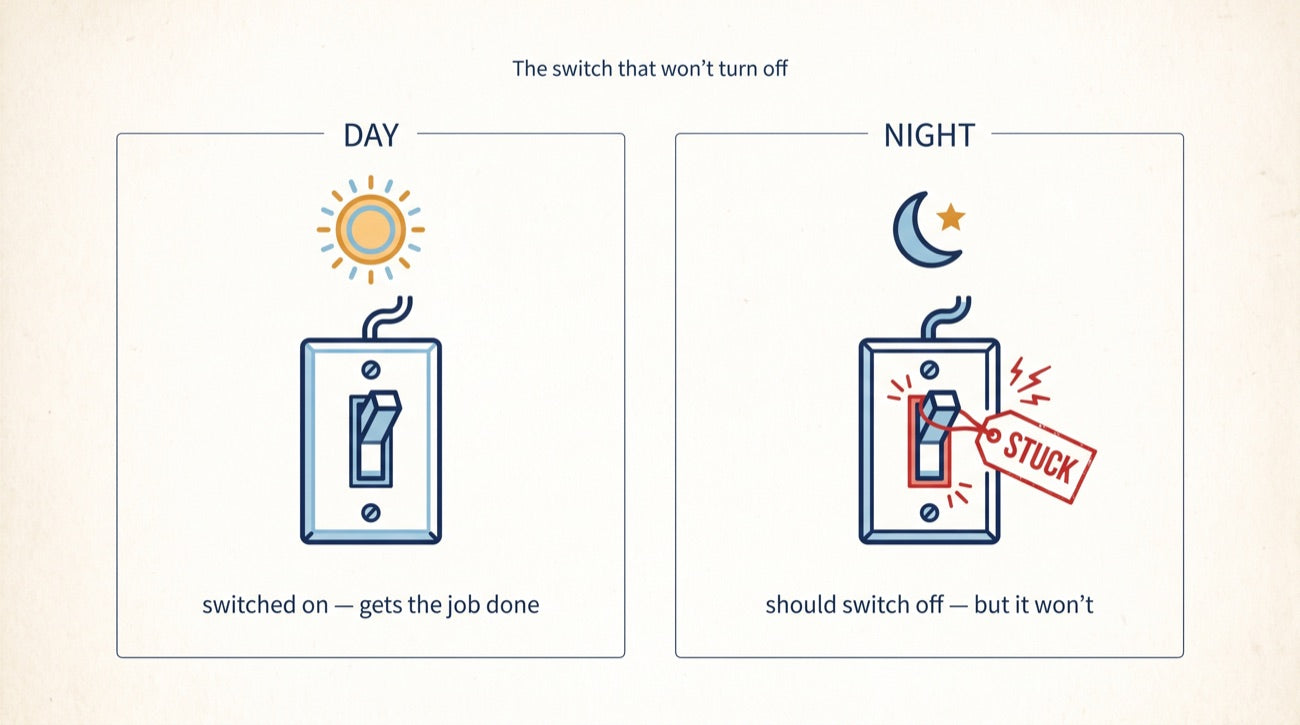
Because it wasn't a disease. It was a switch stuck in the wrong position — one that'd been stuck for years.
The Switch That Forgot How To Turn Off
You've got a system in you — the sympathetic nervous system — that works exactly like a switch (that's the physiology, not us talking). Something needs doing, it flicks ON: the body pumps adrenaline and cortisol, the heart lifts, you're alert, ready, switched on. For thirty years of running a business, that switch was your best mate. It got the job done.
But that switch is meant to flick OFF at night. Cortisol's supposed to be high of a morning to get you up, and drop away come night so the body winds down and you sleep. That's the factory setting.
The trouble is, after decades of the phone, the payroll, the weather, the worry — and then the great big life change of winding it all back — the switch gets stuck. It doesn't flick off anymore. Day and night, the body's still half-braced for a threat that isn't coming.
"When it got explained to me like that, it clicked," Ron says. "The 2am wake-up. The fog. The short fuse. It wasn't five different things gone wrong with me. It was one switch that wouldn't turn off."
That's the wired-but-flat. That's why you're lying there at 2am with the motor still running when everything's quiet. It's not that you've gone soft. It's not just age. It's a switch that forgot how to turn off.
What Happens If You Just Keep Saying You're Fine
This doesn't fix itself. It compounds.
The nights get shorter, so the fuse gets shorter. The fuse gets shorter, so you go quieter. You go quieter, so the people around you start being careful with you.
"Carol stopped asking if I was alright," Ron says. "She just started… being careful. Watching which version of me came out to breakfast. That one stung more than anything."
You stop making plans — the fishing trip, the grandkids' footy — because you never know how much of you there'll be on the day.
And slowly, the thing no one warns a bloke about: you start to feel like you're already on the shelf. Like the useful part of your life is behind you. When the truth is you've got twenty good years left — you just can't feel them through the fog.
Why Nothing In The Bathroom Cupboard Worked
Ron's bedside drawer tells the story. Might be the same as yours.
Magnesium someone told him about. A herbal sleep thing from the chemist. A couple of beers of an evening to "take the edge off" (made the 3am wake-up worse, if anything). "Just push through" as the whole plan.
Some of it helped for a night. None of it held. And there's a reason.
Every one of those works on the symptom — the sleep, the tiredness. A pill to knock you out. A drink to numb it. But none of them touch the thing upstream — the switch that's stuck on, the reason the body won't wind down in the first place.
As a mate put it to Ron: "You can't knock yourself out your way past a switch that won't turn off."
It was never that Ron was slack, or past it, or not tough enough. He was treating the wrong thing.
The Bloke At The Bowls Club Who Put Him Onto It
Wasn't a doctor. Wasn't some wellness thing on the internet.

It was an older bloke down at the bowls club — mid-seventies, sharp as a tack, always good for a laugh. They were sitting having a beer after a game and Ron let slip he was running on four hours a night.
And the old fella just said: "Mate. I was exactly you at your age. Til I stopped chasing the sleep and started sorting out why the thing won't switch off."
He wasn't talking about sleep at all. He was talking about the stress response — and a few natural ingredients that help the body flick the switch back off. Not knock you out. Help it wind down on its own:

Two of the most-studied adaptogens going. Made to help the body handle pressure and support a healthy cortisol rhythm.
For the wired-but-flat.
The stuff the body burns through fastest when it's been braced for years. Supports winding down of a night.
For the 2am wide-awake.
The kind that doesn't leave you flat by mid-morning.
For the fog."I didn't need a science lecture," Ron says. "I needed something that made sense. A switch that's stuck, and something to help turn it off. That, I got."
The Formula Built Around The Switch
It's called Neuravella Cortisol Reset® — Australian owned, 100% natural, built around ashwagandha, rhodiola, magnesium glycinate, L-theanine and B vitamins.

- Supports your natural stress response — the switch, not the symptom
- Supports winding down of a night
- Supports steady, all-day energy — no flat spot
- No caffeine. Non-drowsy. One capsule.
No powders, no shakes, no fuss. No script, no waiting room. It turns up in the post.
"First week, honest? Not much. Nearly wrote it off."
"Week two I got into bed and next thing I knew it was light out. Lay there going — hang on. When did I last sleep through?"
"By week three the 2am thing had eased right off. Waking up with a bit of go in me. Bit sharper."
"Carol said it before I did. Said, 'you're back.' (pause) Reckon I am."

— Ron, 61 · dramatised account based on customer experiences · individual results may vary
GET BACK TO YOURSELF — SHOP NOW →Free shipping · 90-day money-back guaranteeWhat Other Blokes Are Saying

"First time in years I've slept through without waking at 2 doing the numbers. No caffeine in it either, which I liked."

"The fog's what got me. It's lifted. Feel like I've got a bit of go back."

"Wife reckons I'm easier to live with. Reckon that's the highest praise there is."

"Didn't think much would help at my age. Glad I was wrong."
⚠️ Placeholder reviews — replace with real verified reviews before spend (ACCC).
GET BACK TO YOURSELF — SHOP NOW →Free shipping · 90-day money-back guaranteeWhat To Expect
Subtle. Adaptogens build, they don't hit like a pill. Some blokes notice the edge come off first.
This is where it lands for most: switching off faster of a night, fewer 2am wake-ups, the fog lifting, a longer fuse.
The switch settles into its proper rhythm. Most blokes reorder here — not because they have to, but because they remember what running on empty felt like, and they're not going back.
Two Roads
Another 2am staring at the ceiling, doing the maths.
Another flat, foggy morning telling everyone you're fine.
Another year feeling like the useful part's behind you.
You get into bed and you actually switch off. You wake up with something in the tank. The word's there when you reach for it. And that 2am question — am I any use to anyone — gets a lot quieter, because you can feel the answer again.
The Call Ron Nearly Didn't Make
"I added it up — the years of rotten sleep, the beers I didn't need, the version of me my family had been putting up with. This runs about ninety a bottle normally. I got it on the deal for around fifty, free postage, ninety-day guarantee."
"Ninety days. If it does nothing, it's free. At my age you learn NOT giving something a fair go is the real waste."
GET BACK TO YOURSELF — SHOP NOW →Around $50 while the deal's live · free shipping · 90-day money-back guaranteeA switch that's been stuck for years doesn't flick off overnight. But it can be supported — a bit every day.
And there's a difference."
Fair Questions
Is there caffeine in it?
No. None. It's not a pick-me-up — it supports your body winding down on its own. Nothing to crash off.
Will it knock me out or make me groggy?
No. It's non-drowsy and non-habit-forming. It supports steady energy through the day and winding down at night — not sedating you.
How fast?
Adaptogens build with daily use. Most blokes notice the edge come off in week one; the sleep changes usually land weeks 2–4. That's why the guarantee's 90 days, not 30.
How do I take it?
One capsule. That's it. No powders, no shakes.
What's in it?
Ten actives, 100% natural — ashwagandha, rhodiola, magnesium glycinate, L-theanine, B vitamins and more. Australian owned. No script.
What if it does nothing for me?
90-day money-back guarantee. Every cent back, no forms designed to make you give up. Read the label, follow the directions, and if you're on medication have a word to your doctor first.
1. AIHW — men less likely to access health services; higher chronic-condition rates outside major cities.
2. Harvard Health — Understanding the stress response (sympathetic nervous system; adrenaline + cortisol).
3. Cleveland Clinic — Cortisol daily rhythm (high AM, low at night); chronic elevation disrupts sleep.
4. American Psychological Association — chronic stress keeps the sympathetic nervous system firing ("wear-and-tear").
5. Chandrasekhar K. et al. (2012), Indian J Psychol Med — ashwagandha RCT in stressed adults.
6. Olsson E. et al. (2009), Planta Med — rhodiola in stress-related fatigue.
7. Nobre A. et al. (2008) — L-theanine and relaxation.
Studies referenced were conducted on individual ingredients, not the finished product.
*Results may vary. This is a dramatised account based on customer experiences. Always read the label and follow directions for use. If symptoms persist, talk to your health professional. Not intended to diagnose, treat, cure or prevent any disease.
THIS IS AN ADVERTORIAL AND NOT AN ACTUAL NEWS ARTICLE, BLOG, OR CONSUMER PROTECTION UPDATE. © 2026 neuravella. All rights reserved.